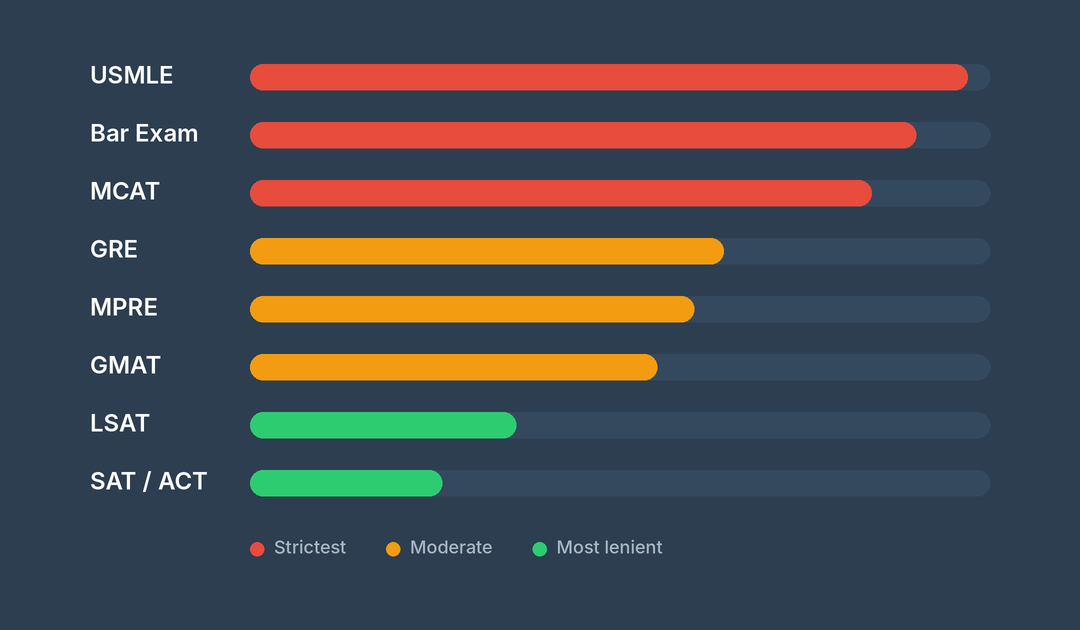
The short answer: The USMLE (run by the NBME), state bar examiners, and the MCAT (run by the AAMC) scrutinize testing accommodation requests the most. ETS (GRE and Praxis), NCBE’s MPRE, and GMAC (GMAT) fall in the middle. The LSAT, SAT, AP, and ACT are the most accommodating, mainly because they rely on prior approvals and school-verified plans rather than re-reviewing every case from scratch.
That ranking matters because the same psychological evaluation can be approved by one testing agency and denied by another. A report that easily secured extra time on the SAT may fall short at the National Board of Medical Examiners. Knowing where your exam sits on the scrutiny spectrum tells you how much documentation you need and how early you need to start.
Dr. Alan Jacobson, a licensed psychologist with more than 25 years of experience, writes accommodations evaluations for every major exam in this guide, from the SAT to the bar exam. What follows is how each agency actually reviews requests, why strict reviewers deny them, and how to build documentation that holds up under the toughest review.
Key Takeaways
- Licensing exams are the hardest. The USMLE and state bar exams protect the public, so reviewers demand the most evidence.
- History matters as much as diagnosis. Strict agencies want proof that your impairment existed long before the exam.
- A diagnosis alone is never enough. Every agency wants to see how the condition limits you under timed testing conditions.
- Prior approvals carry weight. Federal ADA rules require agencies to give considerable weight to accommodations you have received before.
- Start early. The NBME can take about 60 business days to decide, and incomplete files take longer.
Why Do Testing Agencies Differ So Much in How They Review Requests?
Every high-stakes testing agency in the United States follows the same federal rule. Under 28 CFR 36.309, the Americans with Disabilities Act regulation covering examinations, any documentation an agency requests must be reasonable and limited to the need for the accommodation. Agencies must also give considerable weight to past accommodations received in similar testing situations, including those provided under an IEP or Section 504 plan.
The Department of Justice’s technical assistance on testing accommodations goes further. It states that a person with a history of academic success may still qualify, and that proof of past accommodations in similar settings is generally enough to support the same accommodations on a new exam.
Within that federal framework, though, each agency writes its own documentation guidelines, hires its own reviewers, and sets its own threshold for what counts as a functional limitation. Three factors drive how strict an agency becomes:
- What the exam controls. Licensing exams like the USMLE and the bar decide who may practice a profession. Admissions tests decide who gets into a program. The higher the gate, the harder the review.
- Who decides. Some agencies defer to schools or to their own past decisions. Others send every new request to outside expert reviewers.
- How much they rely on history. Agencies that weigh prior approvals heavily move faster. Agencies that insist on independent proof of current impairment move slower and deny more often.
Testing Agencies Ranked by Level of Scrutiny
This table summarizes how each major agency reviews accommodation requests. Requirements change, so always confirm against the agency’s current guidelines before you submit.
| Exam (Agency) | Scrutiny | Who Decides | What Reviewers Focus On |
|---|---|---|---|
| USMLE Step exams (NBME) | Highest | NBME Disability Services | Lifelong history, current functional limitation, personal statement, rationale for each accommodation |
| Bar exam (state jurisdictions) | High, varies by state | Each state’s board of bar examiners | History of accommodations, current documentation, state-specific forms and deadlines |
| MCAT (AAMC) | High | AAMC Accommodation Services | Current functional limitations; prior approvals alone do not qualify you |
| GRE and Praxis (ETS) | Moderate | ETS Office of Disability Policy | Recency rules, full test data, achievement testing even for ADHD |
| MPRE (NCBE) | Moderate | NCBE directly | Documentation and history; separate from any bar exam decision |
| GMAT (GMAC) | Moderate | GMAC | Totality of documentation; flexible about older evaluations |
| LSAT (LSAC) | Lower | LSAC | Automatic approval for prior LSAT accommodations; streamlined review for prior approvals on certain other tests |
| SAT, PSAT, AP (College Board) and ACT | Lowest | Agency, usually through the school’s coordinator | Whether the student has a formal school plan and uses the accommodations on classroom tests |
Tier 1: Which Testing Agencies Are the Strictest?
USMLE Step Exams (NBME)
Among psychologists, disability service offices, and medical students, the NBME has the reputation of being the toughest reviewer in high-stakes testing. Its USMLE test accommodation guidelines require a multi-part personal statement covering your history, current functioning, and rationale for each accommodation. They also require supporting documentation and a certification of the accommodations your medical school has provided.
Medical school disability offices consistently warn students that receiving accommodations in medical school does not guarantee them on the USMLE. Reviewers focus on three questions:
- Did the impairment exist and cause real limitations long before medical school?
- Does current, objective test data show a substantial limitation?
- Is each requested accommodation tied to specific evidence rather than offered as a general recommendation?
If you have no history of accommodations, the NBME expects an explanation of why you did not need them before and why you need them now. Plan for about 60 business days for a decision, longer if anything is missing.
State Bar Examinations
Bar exam accommodations are decided state by state. According to the National Conference of Bar Examiners, each jurisdiction runs its own application process and deadlines, and examinees must apply directly to every jurisdiction where they plan to sit. That means scrutiny ranges widely, and a few jurisdictions are known for repeated requests for additional information.
Bar applicants face added pressure because the exam itself is changing. Between July 2026 and July 2028, most jurisdictions are moving to the NextGen Uniform Bar Exam, a computer-based format. Accommodations that made sense for a paper exam may need a fresh rationale for the new format. Our bar exam accommodations evaluations are written with that transition in mind.
MCAT (AAMC)
The AAMC is explicit that current functional limitations are what qualify you, not a diagnosis and not a previous approval on another standardized test. Its MCAT accommodations guidelines ask for a personal statement describing what you would struggle to do under standard conditions, your accommodation history, and an explanation if you have none. For extended time requests involving neurodevelopmental conditions, the AAMC looks for a history of needing that time. Students preparing an MCAT accommodations evaluation should also expect the same scrutiny again at the USMLE stage, so documentation built to medical-licensing standards pays off twice.
Applying to the USMLE, MCAT, or a state bar? These requests need documentation built for the strictest reviewers from the start.
Schedule a Free ConsultationTier 2: Which Agencies Apply Moderate Scrutiny?
GRE and Praxis (ETS)
ETS is rule-driven rather than unpredictable. Its guidelines for evaluators suggest that an evaluation for a learning disability, ADHD, or autism be completed within the past five years or after age 16. For psychiatric conditions and other conditions that change with treatment, ETS generally wants documentation from within the past year. ETS also asks for academic achievement testing in ADHD evaluations, even when no learning disability is suspected, and it states that a diagnosis alone does not establish the need for accommodations.
ETS has also faced federal oversight. In a settlement with the U.S. Attorney’s Office for the District of New Jersey, ETS agreed to limit its documentation requests and give considerable weight to past accommodations after complaints involving GRE and Praxis test takers. If you are applying for GRE accommodations, a current, complete evaluation remains the most reliable path.
MPRE (NCBE)
Law students often assume their bar exam approval covers the MPRE. It does not. The MPRE is administered at dedicated testing centers, and accommodation requests go directly to NCBE, which handles its own MPRE test accommodations process, appeals, and reconsiderations. NCBE does not make accommodation decisions for state bar exams, so you will apply twice.
GMAT (GMAC)
GMAC reviews requests case by case and looks at the totality of documentation. Notably, GMAC tells candidates to submit what they have even if it is more than five years old, because it cares more about what the documentation shows than about its date. That flexibility helps, but a thin report still gets denied. Our GMAT accommodations evaluations include timed, standardized measures that speak directly to the exam’s demands.
Tier 3: Which Testing Agencies Are the Most Accommodating?
LSAT (LSAC)
LSAC became considerably more accommodating after a 2014 federal consent decree. Under its policy on prior testing accommodations, test takers previously approved on the LSAT are automatically approved for the same or equivalent accommodations when they register again. LSAC also offers a streamlined process for candidates previously approved on certain other standardized admissions tests.
One caution for 2026: as LSAC moves toward in-person testing, some older approvals, such as paper-and-pencil format and remote-testing exceptions granted before August 2025, are no longer carried forward automatically. First-time requests still need solid documentation. See our LSAT accommodations page, or our California LSAT accommodations testing page if you live there.
SAT, PSAT, AP (College Board) and ACT
The College Board’s Services for Students with Disabilities process lets most students with an active IEP, 504 plan, or other formal school plan get approved through school verification, as long as they use the accommodations on classroom tests. Once approved, a student generally stays approved for all College Board tests until a year after high school graduation. ACT also works through the school’s accommodations coordinator.
The weak spot here is the student without a school plan, such as a homeschooled student, a private school student, or a teenager diagnosed recently. Those requests get full review and need independent documentation. Our SAT extended time testing, ACT accommodations, and AP exam accommodations evaluations are designed for exactly those students.
Why Do Strict Testing Agencies Deny Accommodation Requests?
After decades of writing documentation for high-stakes exams, Dr. Jacobson sees the same seven problems behind most denials at the strictest agencies:
- No early history. No report cards, teacher comments, or prior evaluations showing the impairment before college or professional school.
- A recent, first-time diagnosis. Being diagnosed months before the exam invites the question of why the problem never surfaced earlier. A thorough evaluation for undiagnosed ADHD in adults can answer that question with evidence, especially for women whose ADHD was overlooked in childhood.
- Scores in the average range. Under the ADA, reviewers compare you with most people in the general population, not with your high-achieving classmates. Average scores without a clear pattern of limitation are a common reason for denial.
- No validity testing. Without performance and symptom validity measures, reviewers cannot be confident that the results reflect genuine effort and accurate reporting.
- Recommendations without reasons. “Extended time is recommended” is not enough. Each accommodation needs a rationale tied to specific test results.
- Diagnosis without functional impact. A report that confirms ADHD, dyslexia, or anxiety but never explains how it affects timed testing will not succeed.
- A report that reads like advocacy. Reviewers trust objective findings. Reports that sound like they were written to win an argument lose credibility.
How Do You Build a Request That Survives the Strictest Review?
The safest approach is to document every case as if it were going to the NBME. Documentation strong enough for the strictest reviewer will satisfy every other agency too. Dr. Jacobson uses the CLEAR Framework for documenting functional impairment, which links each finding to the legal standard reviewers actually apply.
- Start six months ahead. Evaluation, report writing, agency review, and a possible reconsideration all take time.
- Gather your history first. Collect report cards, prior evaluations, IEPs, 504 plans, college disability office letters, and prior testing approvals. If you never had formal accommodations, informal supports and teacher observations still count.
- Get a comprehensive evaluation. Strong reports include cognitive testing such as the WAIS, achievement testing such as the Woodcock-Johnson, timed reading and processing speed measures, executive functioning assessments, attention measures such as the TOVA, and validity testing.
- Match each accommodation to evidence. If you request 50% extra time, the report should show why 50% and not 25%.
- Keep your personal statement consistent with the report. Reviewers compare them line by line, and contradictions sink requests.
- Request what you actually used. Asking for the same accommodations you used in school or on prior exams is far stronger than asking for new ones.
For more on what the evaluation involves, see what to expect during a psychological assessment and what goes into a psychological testing report. Pricing is covered on our cost of psychological testing page.
What Should You Do If Your Accommodation Request Is Denied?
A denial is not the end of the process. Most agencies, including the NBME, AAMC, and NCBE, offer reconsideration or appeal.
- Read the denial letter closely. It usually names the specific gaps the reviewer found.
- Fix those gaps, not just the tone. Resubmitting the same file with a stronger cover letter rarely works. Add the missing history, test data, or rationale.
- Cite federal guidance where it applies. If the agency ignored your prior accommodations or academic history, point to the DOJ’s position that past accommodations generally support the same accommodations now and that academic success does not rule out a disability.
- Consider a documentation update. A focused update from a qualified psychologist can address exactly what the reviewer flagged without repeating a full evaluation.
Many of our clients come to us after a denial. A virtual evaluation is often the fastest route when an exam date is approaching.
Denied, or worried you will be? Dr. Jacobson is licensed in Massachusetts, California, New York, and New Hampshire and holds PSYPACT authority to provide telepsychology in 44 states.
Book Your ConsultationFrequently Asked Questions
Which testing agency is the hardest to get accommodations from?
The NBME, which reviews requests for the USMLE Step exams, is widely considered the strictest. It requires a detailed personal statement, comprehensive current documentation, and evidence that your impairment caused real limitations long before medical school. State bar examiners and the AAMC, which administers the MCAT, are also known for close review. In contrast, the College Board and LSAC rely heavily on prior approvals and school-verified plans, which makes them considerably easier to work with.
Does an IEP or 504 plan guarantee accommodations on the SAT or ACT?
Not automatically, but it helps a great deal. The College Board approves most students through school verification when they have a formal plan and actually use the accommodations on classroom tests. Approval is not guaranteed if the plan is new, if the student does not use the accommodations, or if the request goes beyond what the plan provides. Students without a school plan, including many private school and homeschooled students, usually need an independent psychological evaluation.
How recent does my evaluation need to be for testing accommodations?
It depends on the agency and the condition. ETS suggests evaluations for learning disabilities, ADHD, and autism be completed within five years or after age 16, and wants psychiatric documentation from within the past year. GMAC will review older documentation in context. The NBME and AAMC focus on current functional limitations, so older reports often need an update. When in doubt, a documentation update from a qualified psychologist is far cheaper than a denial and a missed test date.
Can I get accommodations if I was diagnosed as an adult or never had accommodations before?
Yes. DOJ guidance states that a lack of past accommodations does not prevent you from receiving them now. However, strict agencies will ask why you did not need help earlier. A strong evaluation answers that question with evidence such as compensatory strategies, family support, private tutoring, or school records showing struggles that were never formally addressed. Late diagnosis is especially common for people with high intelligence and for women with ADHD.
Will strong grades hurt my accommodations request?
They can make review harder, but they do not disqualify you. The DOJ’s ADA guidance states that a person with a history of academic success may still have a disability that entitles them to testing accommodations. Strict reviewers may still cite high grades as a reason to deny. Your documentation should explain the cost of that success, such as excessive study hours, reliance on informal supports, or performance that falls apart under time pressure.
Will medical or law schools know I tested with accommodations?
Generally, no. DOJ technical assistance prohibits testing agencies from flagging the scores of test takers who received accommodations, because flagging signals a disability and suggests the scores are less valid. Your score report should look the same as everyone else’s. This is one reason it is worth pursuing accommodations you legitimately need. Using them does not label you to the programs reviewing your application.
What should I do if my accommodation request is denied?
Read the denial letter carefully, because it usually explains what the reviewer found missing. Then request reconsideration or file an appeal through the agency’s process, adding the specific history, test data, or rationale that was lacking. Resubmitting the same file rarely works. A focused documentation update from a psychologist experienced with high-stakes exams can often address the gaps quickly, even when the test date is close.
Official Sources and Further Reading
Testing agency policies change frequently. Always confirm current requirements directly with the agency before submitting a request.
- U.S. Department of Justice: ADA Requirements for Testing Accommodations
- 28 CFR 36.309: Examinations and Courses
- USMLE Test Accommodation Guidelines
- AAMC MCAT Accommodations Guidelines
- ETS Guidelines for Writing Diagnostic Reports
- LSAC Policy on Prior Testing Accommodations
- NCBE MPRE Test Accommodations
- College Board Services for Students with Disabilities
Related: explore all of our accommodations evaluations, including college accommodations and workplace accommodations, or learn more about Dr. Jacobson. Students who need ongoing study and executive functioning support can also explore Therapeutic Tutoring, and Precision Psychological Assessments is part of Foresight Psychological Institute.



 Alan Jacobson, Psy.D., MBA, is a licensed clinical psychologist and Founder & Director of the Foresight Psychological Institute, the parent company of Precision Psychological Testing.